
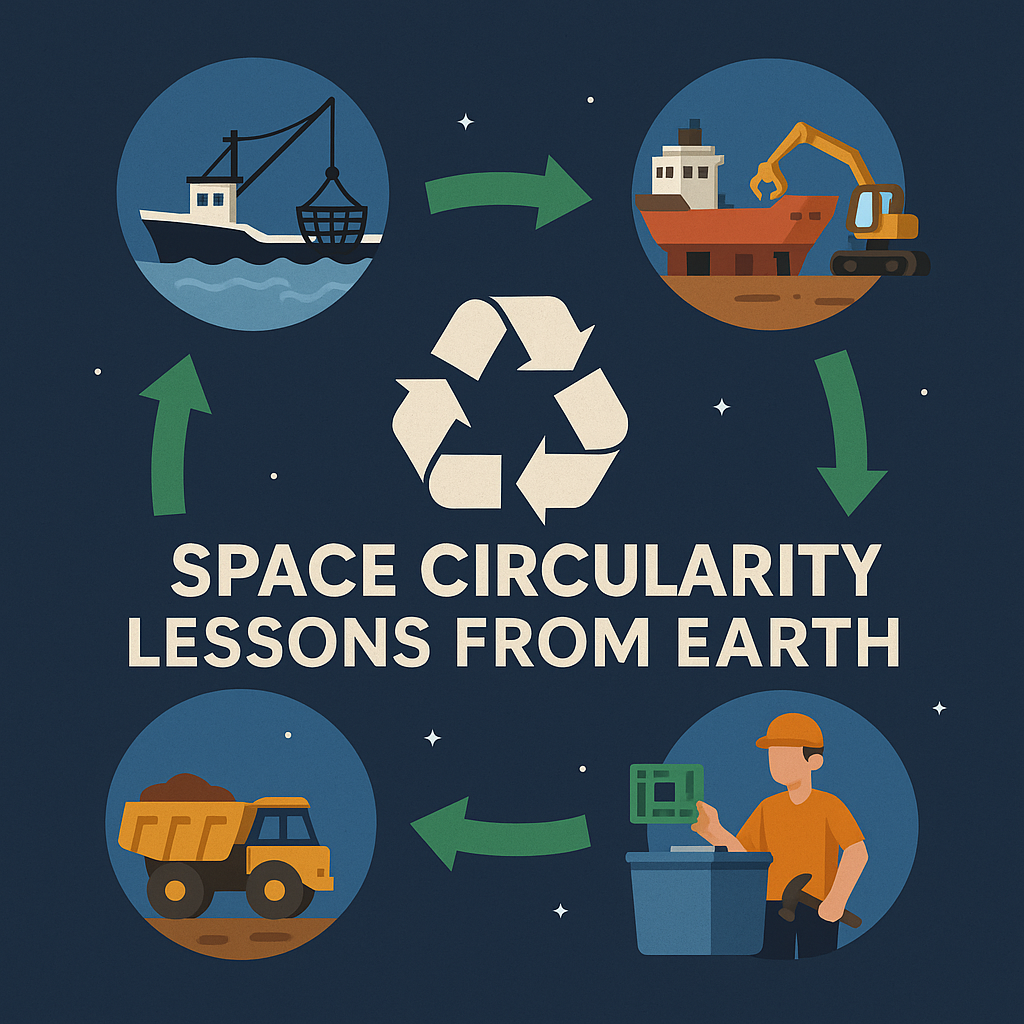
If we want to apply circular economy principles to space, it’s worth looking back to where those principles first gained traction – here on Earth. In recent decades, sectors as diverse as construction, electronics, and even shipping have adopted forms of circular thinking. Not always fully or successfully, but often enough to offer us case studies in what works, what doesn’t, and what might transfer into orbit.
The space environment is extreme, remote, and capital-intensive. But space is also a shared domain – much like the oceans, the atmosphere, or global resource markets. So if we want to think practically about circularity in space, we need to understand what circularity looks like in shared, complex, international systems on Earth.
Finding the Closest Analogues
It’s tempting to reach for obvious comparisons – things like bottle recycling schemes or local composting programmes. But those are tightly bounded, locally managed systems. Space is not like that. It’s a high-cost, high-risk environment with limited access and few natural feedback loops. There is no roadside bin for satellites. No neighbourhood council for orbital debris.
More relevant examples might be found in:
- Electronics waste (e-waste) – high complexity, valuable materials, poor modularity
- Ship dismantling and repair – international regulations, safety risks, cross-border impacts
- Mining and metals recovery – volatile material prices, long investment horizons, ecological externalities
- Oceans and fisheries – shared access, international governance, incentives to overuse without regulation
Each of these systems struggles with many of the same issues space faces: how to regulate common areas, how to assign responsibility, how to create infrastructure where none exists, and how to recover value from assets that weren’t designed for reuse.
E-Waste: Complexity and Low Recoverability
The electronics industry is often held up as a textbook example of how difficult circularity can be. Devices are packed with high-value materials – gold, rare earths, lithium – but extracting them efficiently is hard. Components are small, fused, and often encased in plastics or resins that make disassembly costly.
For years, the dominant model was linear: make, sell, discard. But growing public concern over landfill pollution and resource scarcity began to shift the landscape. Policies like the EU’s WEEE directive, together with corporate take-back programmes and advances in automated disassembly, have made partial circularity viable.
There’s still a long way to go. But what this example shows is that even when economic value exists, circularity doesn’t just happen. It requires deliberate design choices, supportive regulation, and ongoing investment in recovery infrastructure.
In space, where modularity is even lower and accessibility is far more difficult, the bar is higher. And yet, the logic is similar. If we continue to send tens of thousands of satellites into orbit without thinking about how we’ll recover them, we’re locking ourselves into a system where material value – and orbital space – is lost permanently.
Shipbreaking: Risk, Value, and Global Inequities
Large ships, like satellites, are complex, long-lived systems made of high-value materials. They also pose risks at end-of-life – containing hazardous substances like asbestos, heavy metals, and fuel residues. For decades, shipbreaking took place informally on beaches in countries like Bangladesh and India, where environmental and labour standards were low. This created real value – recycled steel, copper, aluminium – but at enormous human and ecological cost.
In response, international conventions like the Hong Kong Convention for the Safe and Environmentally Sound Recycling of Ships were developed to formalise and regulate the process. Implementation has been uneven, but the principle is clear: even when recovery is profitable, regulation is needed to protect shared environmental and human interests.
In space, there are no workers dismantling satellites by hand – but the analogy holds. There are risks, there is value, and there is a gap in regulation. Today, international guidelines exist to encourage responsible disposal – such as the IADC’s 25-year rule and the UN’s Space Debris Mitigation Guidelines – but these are non-binding. Some space agencies, like ESA, have adopted stricter targets under initiatives like the Zero Debris Charter. However, there is no globally enforced agreement on post-mission disposal, and compliance still varies significantly by operator, mission type, and national policy. As in shipbreaking, circularity cannot rely solely on market logic. It needs rules, oversight, and a shared understanding of responsibility.
Oceans and Atmosphere: Commons and Overuse
Perhaps the most direct analogue to space is the ocean – vast, shared, and difficult to govern. Overfishing, marine plastic, and ship emissions all reveal what happens when common domains are left unmanaged. In theory, these environments are protected by multilateral agreements and treaties. In practice, enforcement is patchy and incentives are misaligned.
The tragedy of the commons – where each actor maximises their own use of a shared resource, leading to depletion for all – is already playing out in orbit. Satellites are launched with minimal coordination, orbital slots are increasingly crowded, and collision risk is rising. Debris removal, satellite servicing, and reuse all have collective benefits. But without strong governance or market incentives, they remain rare.
The lesson from Earth’s commons is this: circularity requires more than goodwill. It requires structures that make cooperation not just possible, but economically rational.
What These Analogues Teach Us
Across all these examples – electronics, ships, oceans – a few common threads emerge.
First, design matters. Products or systems not built with reuse in mind are exponentially harder to recover later. Second, infrastructure is essential. Circularity depends on systems for collection, sorting, processing, and redistribution. Third, regulation is a trigger, not a byproduct. Most circular practices became viable only after legal or financial frameworks nudged markets in that direction.
But the final point may be the most important: circularity in shared domains is slow, messy, and never complete. Even the best-run systems still leak waste, require subsidies, and rely on continued political attention. For space, this is both sobering and encouraging. It suggests that building a circular space economy won’t be clean or simple. But it also shows that progress is possible – if we start now, and build deliberately.
