
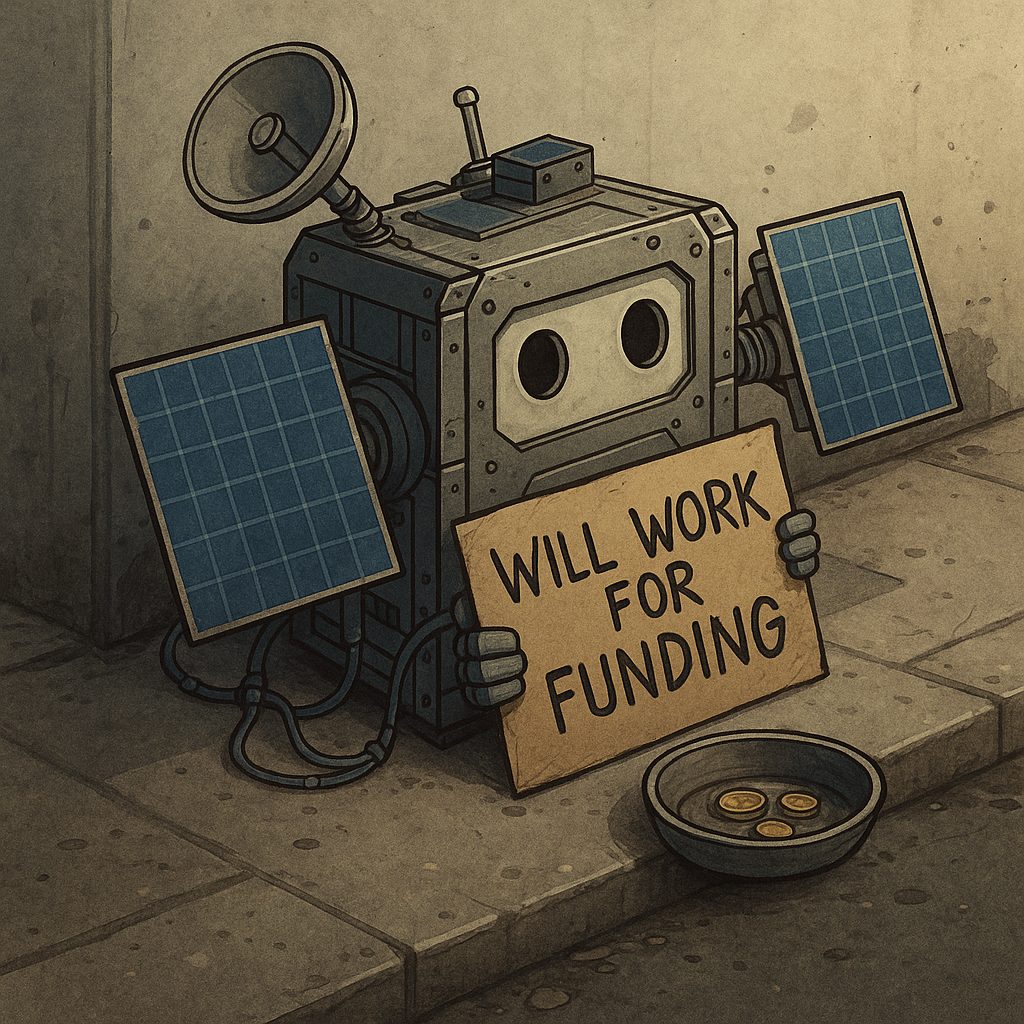
It’s easy to agree that space should be sustainable. It’s harder to make it profitable. For all the talk of orbital recycling, satellite servicing, and debris removal, one question keeps cropping up: who’s going to pay for it — and how?
Circularity is not just a technical challenge, but an economic one. On Earth, we’ve seen this play out across countless industries. Recycling systems that cost more than landfill tend to fail. Reuse models that can’t compete on price don’t scale. Without a business case, circularity remains a good idea trapped in a bad balance sheet.
So what would it take for a circular space economy to be commercially viable? Let’s unpack the assumptions and follow the money.
What Counts as “Circular” in Space?
Before we get too deep into margins and markets, we need to be clear on what we’re counting.
In this context, we’ll define a circular space economy as one where orbital infrastructure is:
- Reused (e.g. via in-orbit servicing, refuelling, or component swaps)
- Recycled (materials recovered and reprocessed, whether in orbit or on Earth)
- Refurbished or extended (life extension via upgrades or repairs)
- Responsibly disposed of (to prevent debris and reduce re-launch costs)
- Built for recovery (designed to enable one or more of the above)
This goes beyond debris mitigation — which is about risk reduction — and moves into value recovery. That’s important, because value is what makes an economy circular. Without it, all you’ve got is cleanup.
Where’s the Money Now?
Currently, the vast majority of commercial activity in space involves:
- Launch
- Satellite manufacturing
- Communications, data, and imagery services
- Ground systems and user terminals
Very little capital flows into the end-of-life phase — unless it’s to satisfy a regulator or secure a licence. In other words, most operators treat disposal as a cost centre, not an opportunity.
There are a few exceptions:
- Life extension services (e.g. Northrop Grumman’s MEV missions) are showing some commercial viability
- Inspection and diagnostic services are emerging for higher-value assets
- Governments are funding debris removal demonstration missions (e.g. ClearSpace-1, Astroscale ADRAS-J)
But the majority of these are either subsidised or focused on public assets. They aren’t yet standalone business models — they’re test cases.
Where Could the Business Value Be?
If a circular space economy is going to pay for itself, one or more of the following levers has to work:
1. Cost Avoidance
Avoiding future launch costs by extending the life of current assets — refuelling, repairing, or reusing — could be the simplest business case.
Assumption: servicing is cheaper than replacing.
Reality: for high-value GEO satellites, this might be true. For mass-produced LEO cubesats? Not yet.
2. Material Recovery
There’s plenty of talk about “gold in them there hills” — the idea that satellites are full of precious metals just waiting to be harvested. While it’s true that they contain aluminium, copper, rare earth elements, and other high-value materials, the volumes are low and the retrieval costs are high.
Assumption: recovering materials in orbit will be worth it someday.
Reality: not without major drops in launch costs, breakthrough automation, and a clear processing pathway. The problem here though, is that falling launch costs undermine the argument for recovering material instead of launching new and also counters the argument for servicing instead of launching new assets.
3. Service Contracts
Operators might pay for clean-up, retrieval, or life extension as a service — especially if insurers, regulators, or public opinion demand it.
Assumption: there’s a market for circularity as a service.
Reality: early signs are promising, but without enforcement or incentives, uptake will remain limited.
4. Insurance and Liability
If insurers offer better premiums for recoverable or serviceable satellites, or if liability regimes get stricter, the economics might tilt.
Assumption: risk pricing will favour circular design.
Reality: the insurance sector is cautious — but influenceable.
5. Regulatory Compliance
If licensing authorities make circularity mandatory — or penalise high-risk designs — then circular practices become not just viable, but necessary.
Assumption: policy will lead market transformation.
Reality: this is plausible, but politically slow.
Who Would Pay — and Why?
The most likely payer in the early stages is government. Not because they’re keen to carry the cost forever, but because they have a vested interest in keeping orbits safe for everyone — and in setting up markets that can eventually sustain themselves.
We’ve seen this model in action before:
- Governments funded early renewable energy markets
- Public subsidies supported early waste recovery schemes
- Regulatory frameworks kickstarted carbon credit markets
In space, the same pattern might apply. Governments fund the early work, incentivise private uptake, and slowly shift the burden.
Commercial operators might then engage if:
- It saves them money
- It earns them credits or reputation
- It secures licensing or insurance advantages
- It avoids future costs (like collisions or regulatory penalties)
What’s Missing Today?
There are three big gaps that keep circularity from pencilling out:
- Infrastructure — There are no operational recycling plants, return systems, or orbital stockpiles
- Standards — No norms exist for modular components, common interfaces, or material recovery
- Markets — No sustained pricing or demand signals for recovered material or end-of-life services
Until these exist — and until they’re backed by enforceable rules or clear economic benefits — circularity will remain a hard sell.
So… Can It Pay for Itself?
Not today — at least not without help.
But in the longer term, with the right mix of policy, design, and coordination, a circular space economy could pay for itself in a few ways:
- Lower launch frequency through reuse and life extension
- Lower collision risk and insurance premiums
- New servicing and refurbishment markets
- Reduced public liability and regulatory risk
- Potential material recovery once scale allows
The path to profitability won’t be quick or guaranteed. But neither was the path for renewable energy, electric vehicles, or recycling on Earth.
Circularity doesn’t have to be immediately profitable — it just has to be progressively rational. If the incentives align, the business case will follow.
