
This may seem a slightly controversial post by the title but stick with it. The answer is yes, but…
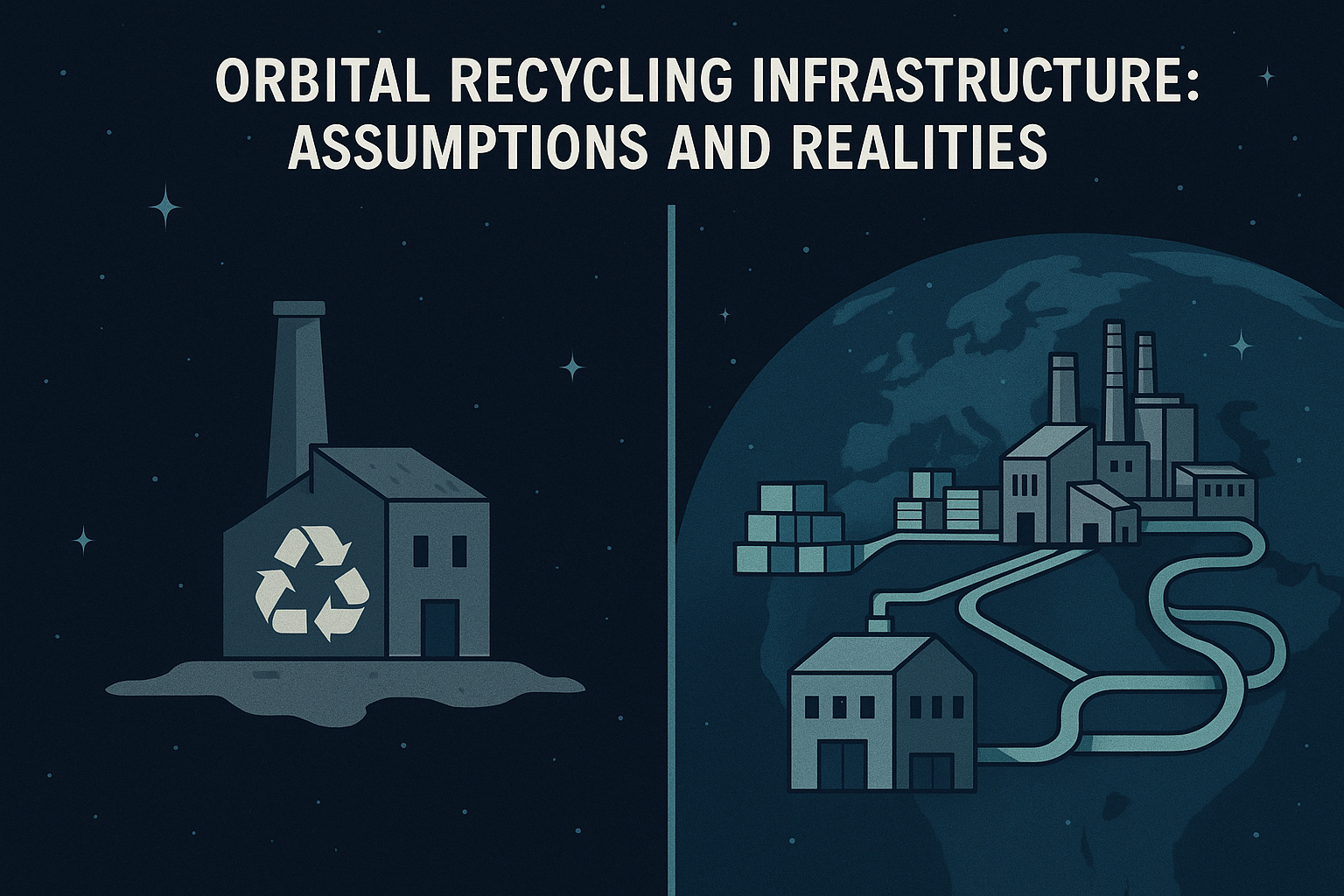
If space is to develop a circular economy, it’s natural to imagine the infrastructure that would support it. One of the most frequently imagined — and most visually compelling — ideas is an orbital recycling station. A place where satellites are towed, disassembled, and reprocessed.
The idea has intuitive appeal. Just as recycling plants on Earth take in old electronics or metal scrap and convert them into useful materials, a space-based facility could supposedly do the same — right where the material already is.
But is that really what the space economy needs? Or is this concept chasing a neat-sounding solution that fails to account for the practical, economic, and environmental realities?
Before investing in orbital recycling dreams, we need to ask: what problem are we actually solving — and is this the best way to solve it?
The Idea of Orbital Recycling
The vision goes like this: satellites that have reached end of life — or have failed in orbit — are collected and delivered to a central station. There, robotic arms or modular service bays carefully dismantle the structure. Useful components are harvested, metals are sorted, batteries are isolated, and raw material is either reused directly or turned into feedstock for future manufacturing.
This infrastructure might orbit in a popular region — say, 600–800 km — where many constellations reside. It might also combine other services: refuelling, storage, even manufacturing.
Some proposals extend the idea further: build solar panels from recovered aluminium. Print new satellite frames using 3D printing. Forge propellant tanks using recycled titanium or composites.
It’s an interesting future, but one that relies on a long list of assumptions — most of which are still unproven, and some of which may be fundamentally flawed.
Assumption 1: There’s Enough Valuable Material in Orbit
The first assumption is one we’ve covered in previous blog posts – that there’s a large and accessible supply of usable material in orbit but, in reality, satellites today are:
- Small
- Integrated
- Degraded by radiation and thermal cycling
- Made of mixed materials and bonded components
The effort required to disassemble and separate those materials — especially without damaging their structure — is non-trivial. Even on Earth, with human workers and specialised machinery, recovering value from e-waste is marginally profitable at best. In orbit, where every gram of machinery must be launched, powered, and controlled remotely, the economics grow even harder.
Worse still, much of what’s already in orbit wasn’t designed for disassembly. Screws, adhesives, multi-layer insulation, fragile solar panels — none of it is intended for handling. It’s not just a technical challenge — it’s a design mismatch.
Assumption 2: In-Orbit Recycling Is Better Than Deorbiting
Another key assumption is that recycling in orbit is preferable to disposing of satellites via controlled re-entry. This deserves more scrutiny.
On Earth, recycling is preferred because disposal usually means landfill or incineration — with long-term environmental harm. In space, the equivalent of disposal is deorbiting into the Earth’s atmosphere, where materials burn up.
This isn’t cost-free. Recent studies have raised concerns about the impact of satellite re-entry on the upper atmosphere — particularly from aluminium oxide particles, which may alter stratospheric chemistry. But these effects are still being studied, and no global regulatory framework yet limits atmospheric re-entry based on emissions.
For now, re-entry remains the most common end-of-life plan, and is far more technically mature than any in-orbit alternative. That doesn’t mean it’s ideal — but recycling in orbit needs to demonstrate it’s not just feasible, but better. Recycling sounds like the greener choice — but until we understand the full lifecycle impacts, controlled re-entry may still be the more practical and predictable end-of-life strategy
Assumption 3: There’s Demand for In-Orbit Materials
Even if you could recover raw materials — aluminium, silicon, or titanium — what would you do with them?
The space economy today doesn’t yet have the manufacturing capacity to reuse raw materials in orbit. 3D printing in space is still at an early stage. Most components are made on Earth using high-precision processes that aren’t currently replicable in microgravity.
And critically, there’s no supply chain for turning mixed orbital scrap into certified satellite-grade hardware in space. Without end-to-end infrastructure — and clear demand — the recycled material has nowhere to go.
Until this changes, the value chain for recycling will remain Earth-bound.
When Might In-Orbit Recycling Make Sense?
That’s not to say in-orbit recycling will never make sense — only that the timing and use case matter.
There may be niche scenarios where orbital recycling is viable:
- Recovering a specific component (e.g. a valuable antenna or propulsion unit)
- Processing large objects like upper stages with known material compositions
- In very high orbits (e.g. GEO), where re-entry is impractical and long-term presence demands a solution
- As part of future in-orbit manufacturing platforms, once demand for raw materials exists on-site
But these are not near-term solutions for the thousands of small satellites now crowding low Earth orbit.
Are We Chasing the Wrong Idea?
Here’s the crux of it: orbital recycling makes sense only if all other parts of the circular economy are already in place — modular design, in-space logistics, in-orbit manufacturing, and economic demand.
If we skip those and start with infrastructure, we risk building a solution in search of a problem.
A better use of effort might be to focus on:
- Designing satellites for servicing and disassembly
- Developing logistics systems (like tugs or collection networks)
- Creating economic incentives for reuse, refurbishment, or recovery
- Encouraging international norms that penalise wasteful disposal
Only then might the case for in-orbit recycling become viable — as part of a larger, functional system.
Conclusion: Infrastructure Follows Intent
The dream of orbital recycling plants is not misguided — but maybe it is premature.
Circular economies don’t begin with factories — they begin with design choices, policies, and behaviours. Infrastructure follows those changes, not the other way around.
Rather than rushing to build hardware in orbit, we should be asking how circular principles can be embedded from launch to disposal — and whether the costs of recycling can be justified by the benefits it brings.
Until the rest of the system is ready, building a space-based recycling plant may be less a leap forward — and more a distraction.
