
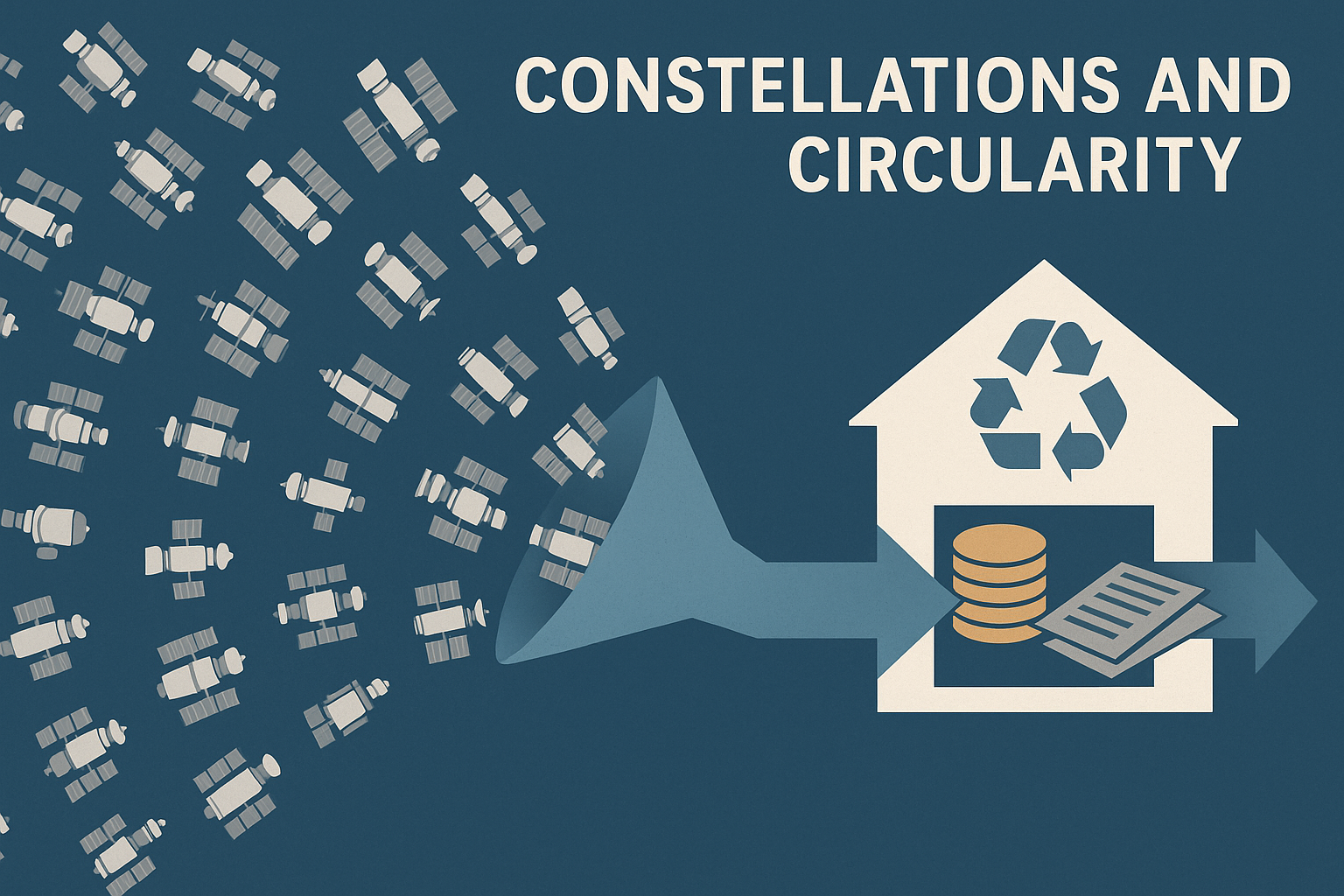
Conversation about circularity in space often returns to the same foundational question: what are we trying to recycle, exactly?
While the term might conjure images of defunct satellites or upper stages from long-abandoned missions, the most pressing objects to consider aren’t relics of the past — they’re the small, operational satellites being launched today in their thousands. These are the building blocks of the so-called ‘new space economy’, and they form the bulk of what’s now crowding Low Earth Orbit.
At the heart of this transformation are satellite constellations. Companies like SpaceX, OneWeb, and Amazon have led a surge in low-cost, high-volume deployments — changing not only the economics of space, but its physical environment. If we want to build a circular economy in orbit, these constellations must sit at the centre of the discussion.
So, can we recycle them? And more to the point — does it make sense to try?
A Different Kind of Satellite
Legacy satellites were often large, bespoke systems built for single missions over ten or fifteen years. They were expensive and tended to operate in high orbits, with specific slots and clear separation.
By contrast, modern constellation satellites — particularly in LEO — are:
- Mass-produced, sometimes hundreds per month
- Designed for lifespans of 5–7 years
- Often lacking modular design features
- Compact, lightweight, and minimally serviceable
A typical unit weighs 150–300 kg and carries just enough equipment to serve its specific communication or Earth observation function. Everything is integrated, miniaturised, and tightly packed to minimise volume and cost per launch.
This presents immediate challenges for recovery or reuse. Where older, larger spacecraft might justify a complex salvage mission, a single smallsat from a constellation almost never will.
Material Value: The Myth of Satellite Gold
Constellation satellites are not worthless in material terms. Most include:
- Aluminium structural elements and shielding
- Lithium-ion batteries with cobalt or nickel
- Silicon solar panels, often with rare earth dopants
- Copper and gold in circuit boards and connectors
But these materials, while valuable in bulk, are difficult to extract from such small, bonded, and degraded objects — especially in orbit. The gold is there, metaphorically and literally, but not in the quantities or accessibility needed to justify economic recovery on a one-off basis.
On Earth, we already struggle to make e-waste recycling profitable0000, and that’s with ground-based infrastructure and established supply chains. In space, where accessibility is low and processing is nonexistent, the economics shift dramatically — and not in favour of recycling.
Scale without Infrastructure
What makes the constellation challenge unique is scale. We’re not talking about dozens of satellites, but tens of thousands. SpaceX’s Starlink constellation alone has approval for over 30,000 satellites, and other companies are not far behind.
From a circular economy perspective, scale is both a problem and an opportunity. On the one hand, more satellites mean more congestion, more material in orbit, and more eventual waste — especially if satellites are allowed to fail in place or deorbit uncontrolled.
On the other hand, scale enables standardisation. If thousands of units are built to identical specifications, there is at least the potential to create shared servicing models, modular designs, or even targeted recovery tools. But that requires design alignment across companies — and possibly regulation — none of which currently exists.
At present, each operator designs their satellites to their own proprietary standards, often with little thought for reuse or interoperability. And without an incentive to align designs or cooperate post-mission, the default is linear: launch, operate, dispose.
Reuse vs. Recovery: A More Realistic Path?
Given the difficulty of full recycling, some have proposed a shift in mindset — away from material recovery and towards component reuse or life extension.
This could mean:
- Designing satellites with detachable modules (e.g. propulsion, power, comms)
- Including grapple points or service ports for in-orbit servicing
- Developing standardised bus formats that allow for upgrades or hardware swaps
- Using autonomous orbital tugs to reposition or refuel failed units
This vision moves closer to circularity by extending use, reducing redundancy, and deferring disposal. But it also moves the goalposts. We’re no longer talking about recycling in the strict sense, but about designing for longevity and adaptability — which is often a more achievable first step.
Constellation operators may not be incentivised to adopt these ideas voluntarily, especially while launch remains relatively cheap. But if regulation or public pressure starts to shift — or if orbital congestion becomes a serious liability — these reuse models may begin to gain traction.
Are Constellations Fundamentally Anti-Circular?
Not inherently. But their current design logic is.
Constellations are built around volume, scale, and low per-unit cost. This encourages minimal hardware, no servicing, and limited lifespan. Every design decision optimises for rapid deployment, not long-term sustainability.
To move constellations into a circular future, the logic needs to change. That could mean incentives for designing serviceable or modular units, licensing that requires end-of-life planning beyond reentry or international standards for interoperability or safe recovery.
Or it could mean economic tools — levies, debris offset markets, or shared orbital servicing infrastructure that lowers the cost of circular practices.
What’s clear is that left to current market dynamics, constellation satellites will continue to accumulate and decay — not circulate.
Circularity at Scale Must Be Intentional
The power of constellations comes in their scale. This poses both a threat and an opportunity. The sheer mass in orbit represents a growing environmental hazard — but the fact that just a few companies control such large portions of the infrastructure also creates a unique influence point. If those operators adopt circular design principles, their choices could have ripple effects across the entire industry, setting new norms and driving wider adoption.
Circularity is not incompatible with this model. But it won’t emerge by accident. It will need to be designed, incentivised, and in some cases, required. As space becomes busier, and access more valuable, the logic of ‘launch and burn’ may begin to falter. Whether that happens soon enough to matter remains to be seen.
