
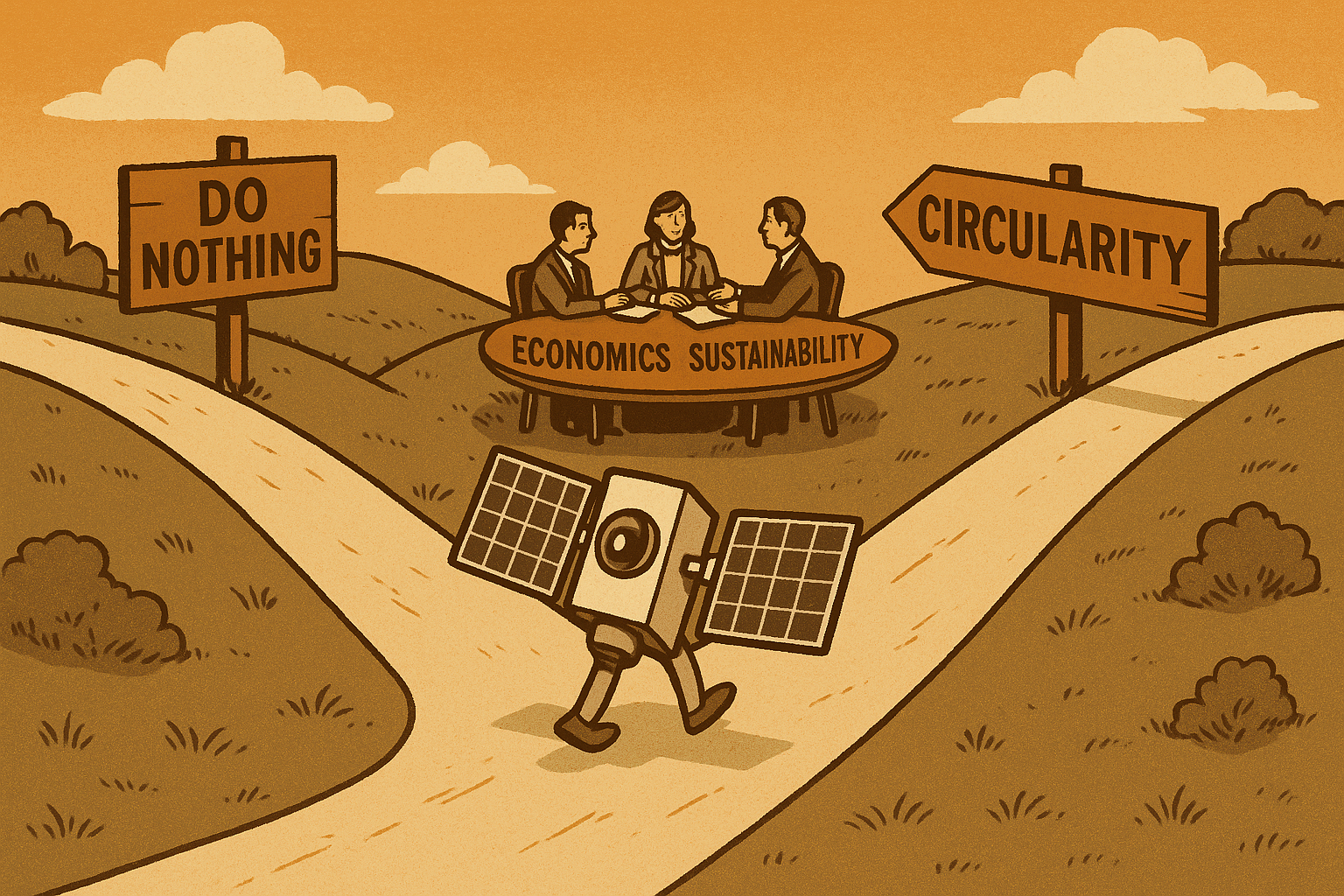
After a few weeks of pulling apart the components, actors, systems, and incentives that might form a circular space economy, it’s time to step back. Not to wrap things up with a neat bow — but to ask a more fundamental question.
Is the circular space economy actually a useful concept? Or are we applying a familiar Earth-bound idea to a vastly different context, simply because it sounds progressive?
Circularity in Orbit: A Useful Lens — or a Misfit?
“Circular economy” has gained traction across sustainability discussions for good reason. On Earth, it offers an alternative to the traditional linear model — take, make, dispose — by promoting reuse, repair, recycling, and regeneration. It’s a vision that challenges wastefulness and unlocks long-term value.
It also helps consolidate a diverse set of space sustainability efforts — satellite servicing, modular design, orbital recycling, return-to-Earth missions — into a single framework. That clarity has value. Policymakers, funders, and the public need a way to understand complex systems. Circularity offers a story arc — from problem to solution — and gives us language to imagine progress.
But stories carry assumptions, and this one risks obscuring how different space really is.
On Earth, waste is usually centralised, physically accessible, and relatively easy to recover. In orbit, the material we want to reuse or recycle is fast-moving, scattered across altitudes, and expensive to reach. Terrestrial recycling relies on proximity — processing centres near consumers, predictable logistics, and well-established supply chains. In space, by contrast, infrastructure is sparse and disconnected. There is no natural hub. No shared collection network. No economy of scale.
Even the idea of “material value” becomes problematic. Many satellites do contain aluminium, copper, and rare earth elements — but not in quantities that obviously justify recovery. The economics just aren’t there yet.
Still, we shouldn’t dismiss the framework entirely. Circularity may not fit perfectly — but it prompts important questions. How do we design for longevity? How do we extract more value from what we’ve already launched? How do we avoid passing the cost of today’s infrastructure onto tomorrow’s operators?
Even if the full loop — recycle, reuse, remanufacture — never closes in orbit, the mindset that circularity encourages is worth keeping. Nowadays, humanity really should be cognisant of needing to protect and preserve any environment in which it ventures.
Why Circularity Might Matter More Than We Think
There are also some deeper reasons to hang onto the concept — ones that go beyond short-term economic logic.
First, our current dominant method of disposal — burning up satellites in Earth’s atmosphere — may not remain acceptable forever. Recent research suggests that re-entry might leave behind metal particulates in the upper atmosphere. If the scale of re-entry increases dramatically, as projected with large constellations, we may face environmental constraints that force us to rethink atmospheric disposal entirely. If we can’t throw things away, we’ll need to get serious about recovery. Let’s be clear though, the research is nascent and my phrasing of ‘if, may and might’ is deliberate. If it’s shown the damage is very minimal and reversible, then do not expect commercial business to move away from the current fiery disposal methods for a very long time.
Second, space isn’t static. Over the very long term, we will need far more infrastructure in orbit — not just satellites, but depots, factories, transport hubs, and habitats. That future will depend on capabilities like in-orbit manufacturing, robotic servicing, and component standardisation. In other words, even if circularity doesn’t fully pay off today, its building blocks are directly aligned with the technical needs of a spacefaring economy.
Circularity might not be the final goal — but it may be the training ground for something more ambitious.
Are There Better Ways to Frame This?
If circularity doesn’t quite map to the current reality, are there other ways to talk about space sustainability that avoid the mismatches?
Some options include:
- Responsible Stewardship – This frames sustainability as an ethical obligation — a matter of leaving orbital space in a safe and usable condition for others. It avoids the economic framing and focuses on duty.
- Sustainable Access – A more practical approach, this focuses on keeping space open, usable, and safe — managing traffic, avoiding collisions, and preventing long-term contamination.
- Infrastructure Resilience – This engineering-led view focuses on building orbital systems that are robust, adaptable, and serviceable — regardless of whether they’re circular. Circularity becomes a method, not a mandate.
Each framing has its uses. The point isn’t to crown one “correct” model — it’s to ensure that we choose language that encourages progress, rather than distracting from it.
A Concept Worth Keeping — But Not Worshipping
Circularity in space might never look like it does on Earth. That’s fine. The usefulness of the concept isn’t in its perfection — it’s in how it shapes our behaviour.
If it prompts better design, longer-term thinking, and shared responsibility, then it’s doing important work — even if the loop never fully closes.
But if we start treating it as the only acceptable model — or let it mask the very real differences between terrestrial and orbital systems — then we risk misdirecting effort and setting unrealistic expectations.
Circularity should be a lens, not a dogma. Let’s use it where it fits, adapt it where it doesn’t, and stay open to whatever frameworks emerge next.
Because the goal, in the end, isn’t buzzwords — it’s sustainability.
